Spend the Night With The Masters
April 1st, 1987
Spend the Night With the Masters
A press clipping from the hotel’s history archive — originally published in Orange Coast Magazine, April 1987, by Ron Eggers.
Before the Big Bear Inn, today's Chateau Big Bear Boutique Hotel, had even finished welcoming its first guests, it had already caught the attention of Orange Coast Magazine — not for its rooms, but for what hung on its walls. Here’s that 1987 profile in full.
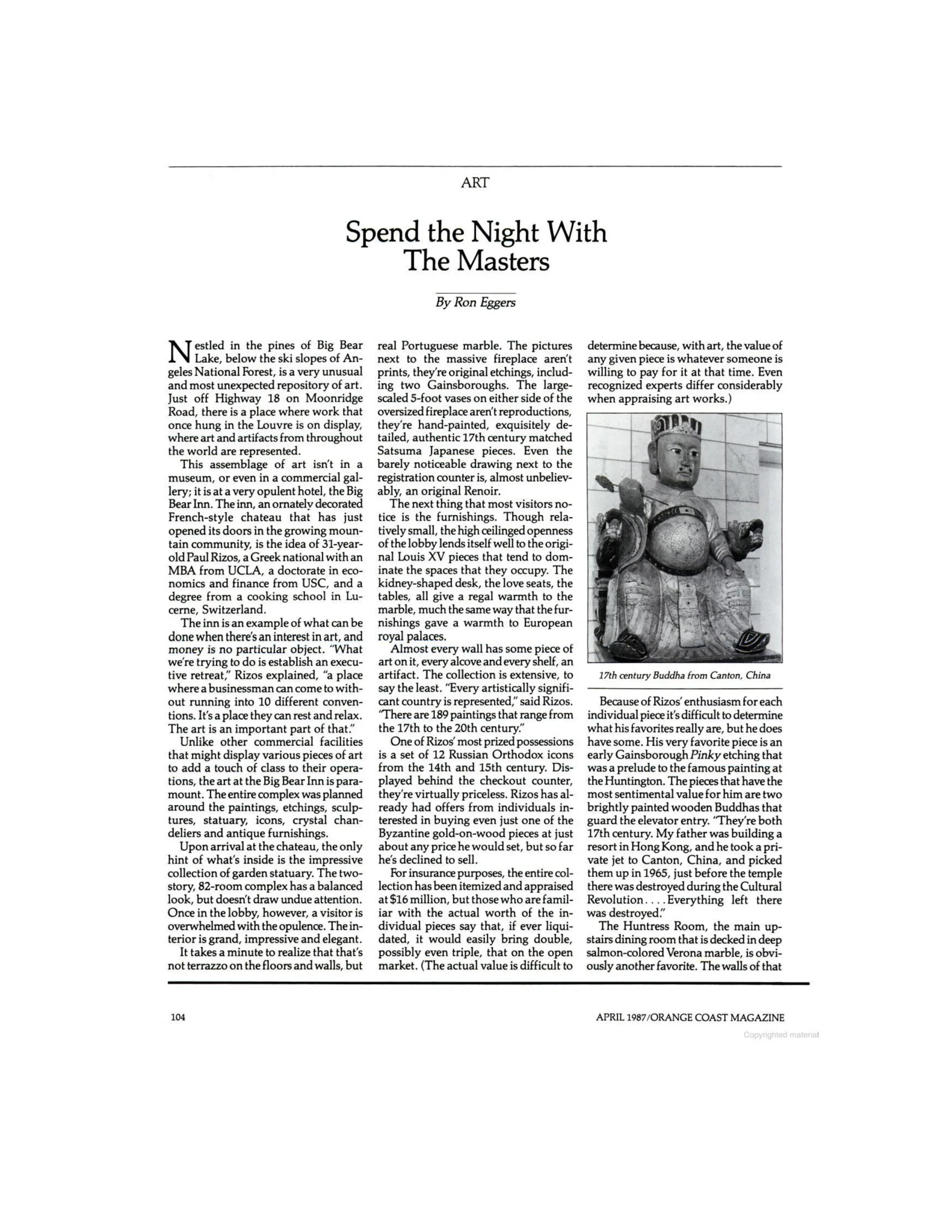
Nestled in the pines of Big Bear Lake, below the ski slopes of Angeles National Forest, is a very unusual and most unexpected repository of art. Just off Highway 18 on Moonridge Road, there is a place where work that once hung in the Louvre is on display, where art and artifacts from throughout the world are represented.
This assemblage of art isn’t in a museum, or even in a commercial gallery; it is at a very opulent hotel, the Big Bear Inn. The inn, an ornately decorated French-style chateau that has just opened its doors in the growing mountain community, is the idea of 31-year-old Paul Rizos, a Greek national with an MBA from UCLA, a doctorate in economics and finance from USC, and a degree from a cooking school in Lucerne, Switzerland.
The inn is an example of what can be done when there’s an interest in art, and money is no particular object. “What we’re trying to do is establish an executive retreat,” Rizos explained, “a place where a businessman can come to without running into 10 different conventions. It’s a place they can rest and relax. The art is an important part of that.”
Unlike other commercial facilities that might display various pieces of art to add a touch of elegance to their operations, the art at the Big Bear Inn is paramount. The entire complex was planned around the paintings, etchings, sculptures, statuary, icons, crystal chandeliers and antique furnishings.
Upon arrival at the chateau, the only hint of what’s inside is the impressive collection of garden statuary. The two-story complex has a balanced look, but doesn’t draw undue attention. Once in the lobby, however, a visitor is overwhelmed with the opulence. The interior is grand, impressive and elegant.
It takes a minute to realize that’s not terrazzo on the floors and walls, but real Portuguese marble. The pictures next to the massive fireplace aren’t prints; they’re original etchings, including two Gainsboroughs. The large-scaled 5-foot vases on either side of the oversized fireplace aren’t reproductions; they’re hand-painted, exquisitely detailed, authentic 17th century matched Satsuma Japanese pieces. Even the barely noticeable drawing next to the registration counter is, almost unbelievably, an original Renoir.
The next thing that most visitors notice is the furnishings. Though relatively small, the high ceilinged openness of the lobby lends itself well to the original Louis XV pieces that tend to dominate the spaces that they occupy. The kidney-shaped desk, the love seats, the tables, all give a regal warmth to the marble, much the same way that the furnishings give a warmth to European royal palaces.
Almost every wall has some piece of art on it, every alcove and every shelf, to say the least. The collection is extensive, to say the least. “Every artistically significant country is represented,” said Rizos. “There are 189 paintings that range from the 17th to the 20th century.”
One of Rizos’ most prized possessions is a set of 12 Russian Orthodox icons from the 14th and 15th century. Displayed behind the checkout counter, they’re virtually priceless. Rizos has already had offers from individuals interested in buying even just one of the Byzantine gold-on-wood pieces at just about any price he would set, but so far he’s declined to sell.
For insurance purposes, the entire collection has been itemized and appraised at $16 million, but those who are familiar with the actual worth of the individual pieces say that, if ever liquidated, it would easily bring double, possibly even triple, that on the open market. (The actual value is difficult to determine because, with art, the value of any given piece is whatever someone is willing to pay for it at that time. Even recognized experts differ considerably when appraising art works.)
Because Rizos’ enthusiasm for each individual piece is so infectious, it’s difficult to determine what his favorites really are, but he does have some. His very favorite piece is an early Gainsborough Pinky etching that was a prelude to the famous painting at the Huntington. The pieces that have the most sentimental value for him are two brightly painted wooden Buddhas that guard the elevator entry. “They’re both 17th century. My father was building a resort in Hong Kong, and he took a private jet to Canton, China, and picked them up in 1965, just before the temple there was destroyed during the Cultural Revolution.... Everything else there was destroyed.”
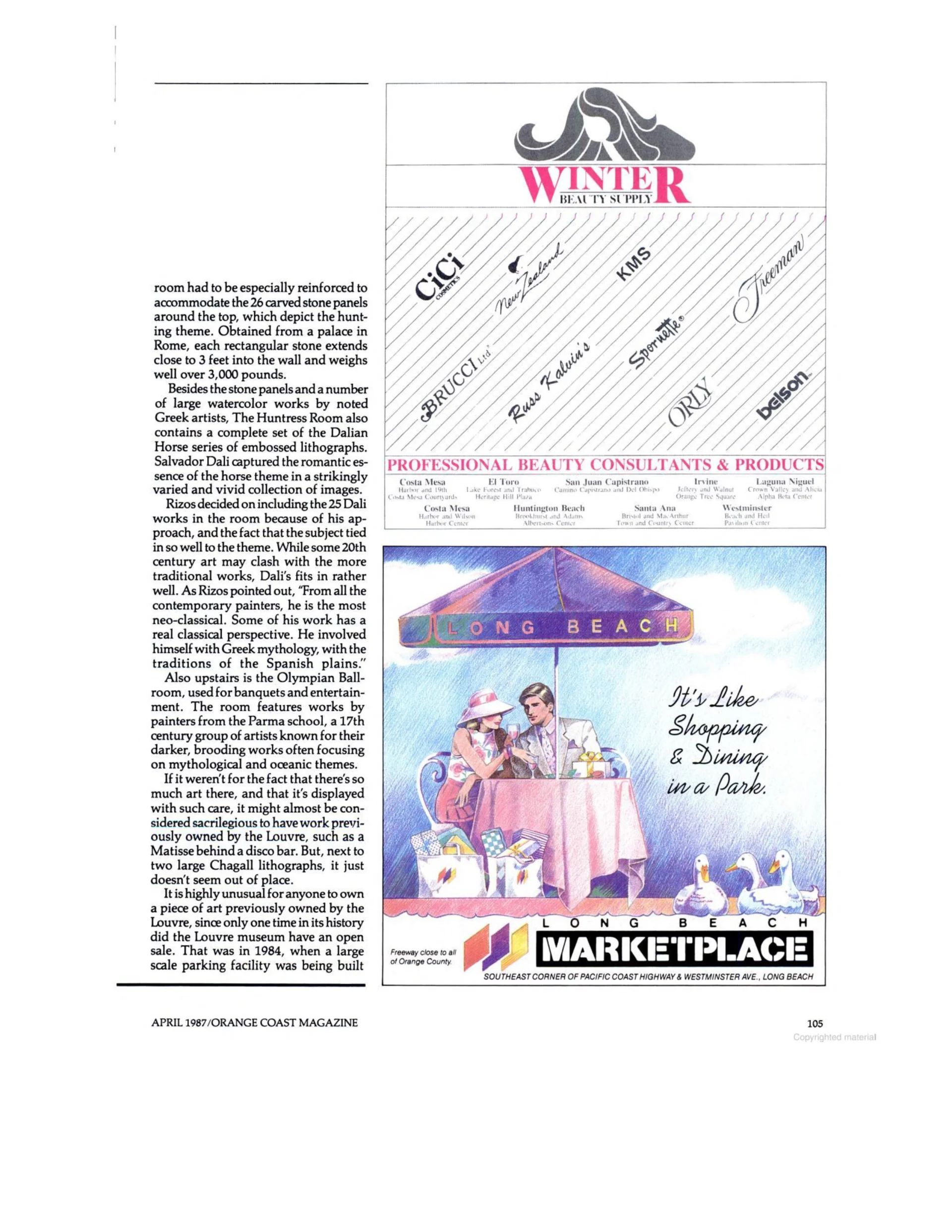
The Huntress Room, the main upstairs dining room that is decked in deep salmon-colored Verona marble, is obviously another favorite. The walls of that room had to be especially reinforced to accommodate the 26 carved stone panels around the top, which depict the hunting theme. Obtained from a palace in Rome, each rectangular stone extends close to 3 feet into the wall and weighs well over 3,000 pounds.
Besides the stone panels and a number of large watercolor works by noted Greek artists, The Huntress Room also contains a complete set of the Dalian Horse series of embossed lithographs. Salvador Dali captured the romantic essence of the horse theme in a strikingly varied and vivid collection of images.
Rizos decided on including the 25 Dali works in the room because of his approach, and the fact that the subject tied in so well to the theme. While some 20th century art may clash with the more traditional works, Dali’s fits in rather well. As Rizos pointed out, “From all the contemporary painters, he is the most neo-classical. Some of his work has a real classical perspective. He involved himself with Greek mythology, with the traditions of the Spanish plains.”
Also upstairs is the Olympian Ballroom, used for banquets and entertainment. The room features works by painters from the Parma school, a 17th century group of artists known for their darker, brooding works often focusing on mythological and oceanic themes.
If it weren’t for the fact that there’s so much art there, and that it’s displayed with such care, it might almost be considered sacrilegious to have work previously owned by the Louvre, such as a Matisse behind a disco bar. But, next to two large Chagall lithographs, it just doesn’t seem out of place.
It is highly unusual for anyone to own a piece of art previously owned by the Louvre, since only one time in its history did the Louvre museum have an open sale. That was in 1984, when a large scale parking facility was being built during a time when the French government was cutting support. To raise money to complete the project, the museum had to resort to selling works from its collection. It sold more than 250 pieces from its undisplayed items.
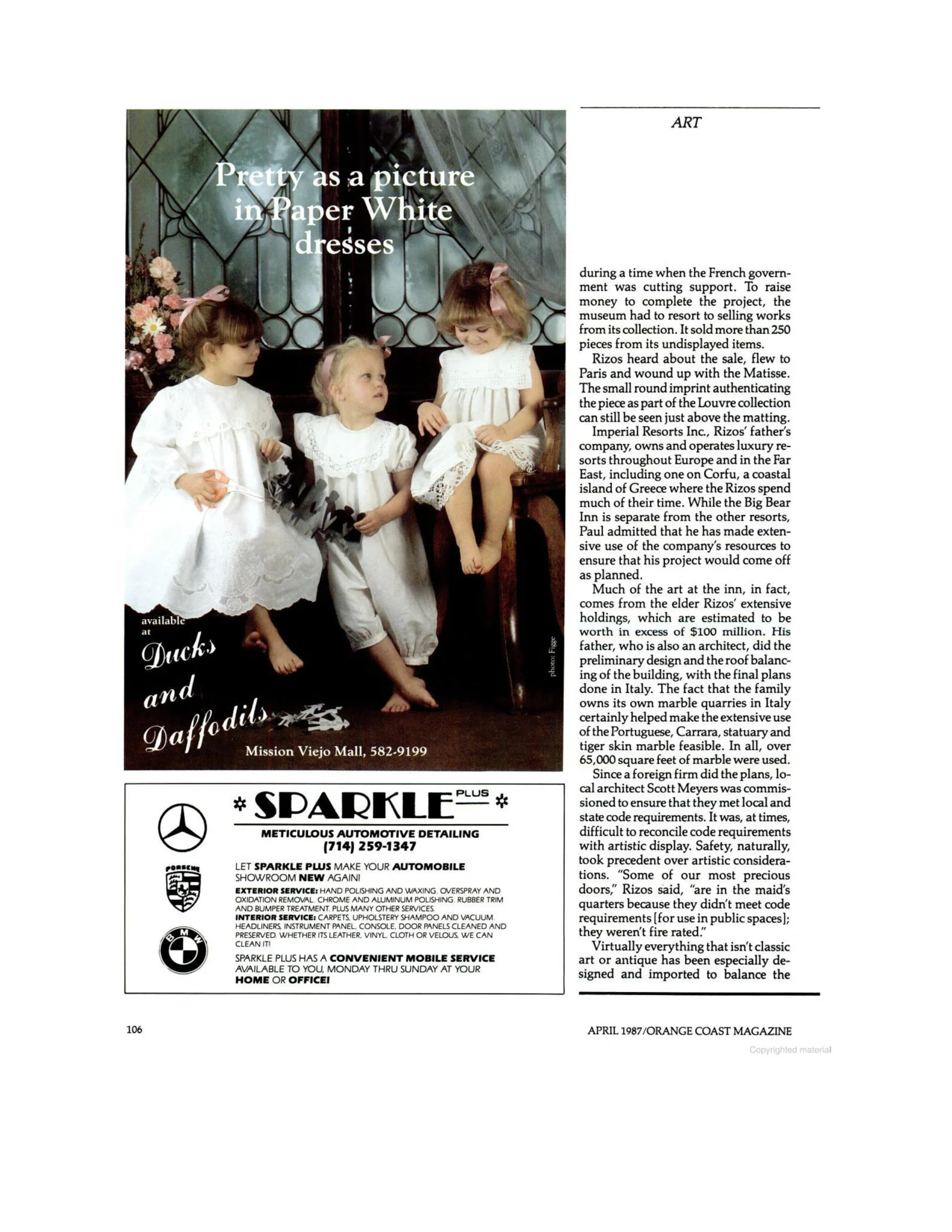
Rizos heard about the sale, flew to Paris and wound up with the Matisse. The small round imprint authenticating the piece as part of the Louvre collection can still be seen just above the matting.
Imperial Resorts Inc., Rizos’ father’s company, owns and operates luxury resorts throughout Europe and in the Far East, including one on Corfu, a coastal island of Greece where the Rizos spend much of their time. While the Big Bear Inn is separate from the other resorts, Paul admitted that he has made extensive use of the company’s resources to ensure that his project would come off as planned.
Much of the art at the inn, in fact, comes from the elder Rizos’ extensive holdings, which are estimated to be worth in excess of $100 million. His father, who is also an architect, did the preliminary design and the roof balancing of the building, with the final plans done in Italy. The fact that the family owns its own marble quarries in Italy certainly helped make the extensive use of the Portuguese, Carrara, statuary and tiger skin marble feasible. In all, over 65,000 square feet of marble were used.
Since a foreign firm did the plans, local architect Scott Meyers was commissioned to ensure that they met local and state code requirements. It was, at times, difficult to reconcile code requirements with artistic display. Safety, naturally, took precedent over artistic considerations. “Some of our most precious doors,” Rizos said, “are in the maid’s quarters because they didn’t meet code requirements [for use in public spaces]; they weren’t fire rated.”
Virtually everything that isn’t classic art or antique has been especially designed and imported to balance the original objects, not as reproductions of earlier works, but as examples of contemporary craft.
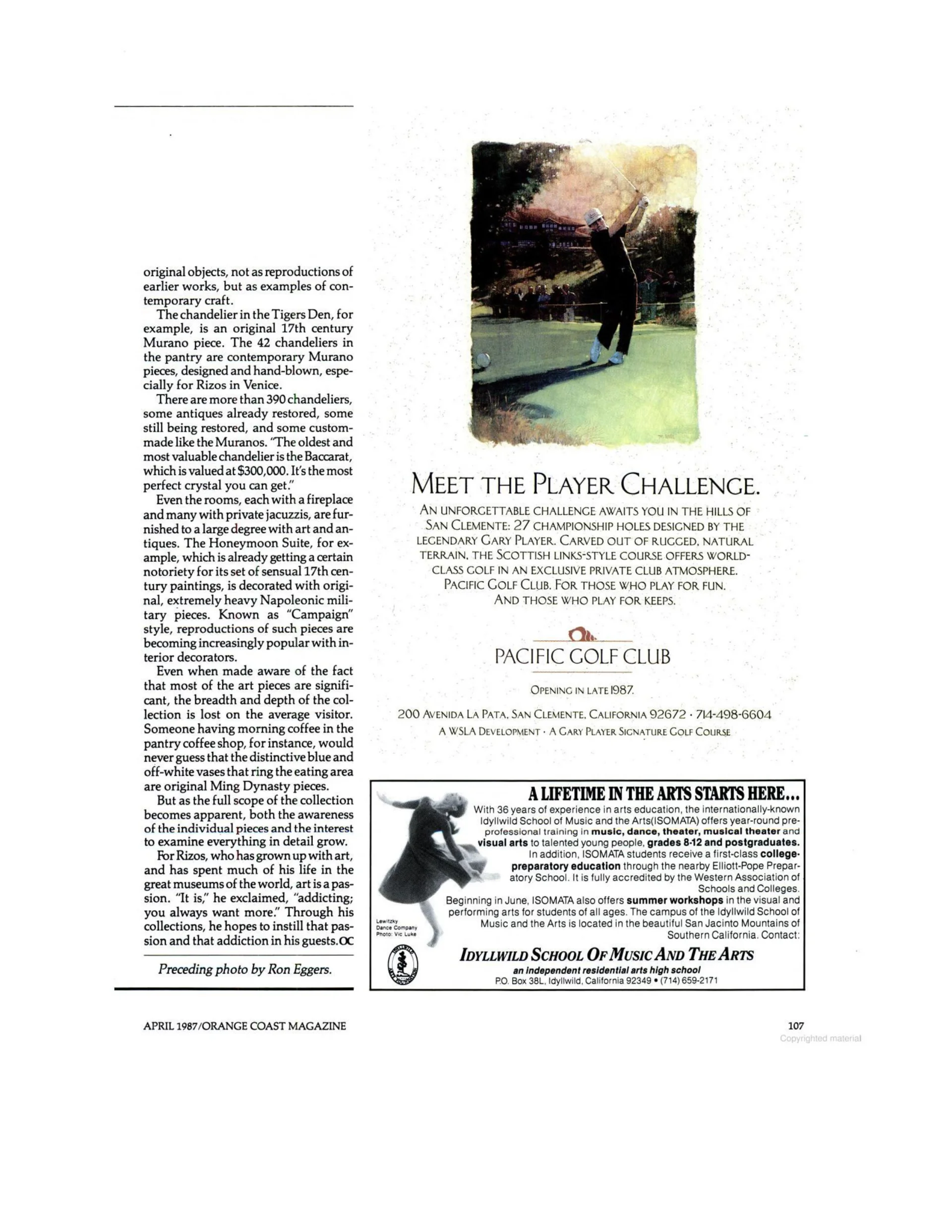
The chandelier in the Tigers Den, for example, is an original 17th century Murano piece. The 42 chandeliers in the pantry are contemporary Murano pieces, designed and hand-blown, especially for Rizos in Venice.
There are more than 390 chandeliers, some antiques already restored, some still being restored, and some custom-made like the Muranos. “The oldest and most valuable chandelier is the Baccarat,” which is valued at $300,000. “It’s the most perfect crystal you can get.”
Even the rooms, each with a fireplace and many with private jacuzzis, are furnished to a large degree with art and antiques. The Honeymoon Suite, for example, which is already getting a certain notoriety for its set of sensual 17th century paintings, is decorated with original, extremely heavy Napoleonic military pieces. Known as “Campaign” style, reproductions of such pieces are becoming increasingly popular with interior decorators.
Even when made aware of the fact that most of the art pieces are significant, the breadth and depth of the collection is lost on the average visitor. Someone having morning coffee in the pantry coffee shop, for instance, would never guess that the distinctive blue and off-white vases that ring the eating area are original Ming Dynasty pieces.
But as the full scope of the collection becomes apparent, both the awareness of the individual pieces and the interest to examine everything in detail grow.
For Rizos, who has grown up with art, and has spent much of his life in the great museums of the world, art is a passion. “It is,” he exclaimed, “addicting; you always want more.” Through his collections, he hopes to instill that passion and that addiction in his guests.
— Ron Eggers, Orange Coast Magazine, April 1987. Preceding photos by Ron Eggers.
The Collection Today
Much of the art described in this 1987 profile left when Mr. Rizos sold the hotel but some remain part of Chateau Big Bear’s collection today, part of the same old-world atmosphere later described in European Elegance at Big Bear Prices (1992) and Weekend Time Out (1993).
Frequently Asked Questions
What is the art collection at Chateau Big Bear worth?
As of this 1987 profile, the hotel’s art collection — including 189 paintings, Russian Orthodox icons, and pieces once owned by the Louvre — was insured for $16 million, with some estimates placing its true market value at two to three times that figure.
Who assembled the art collection?
Paul Rizos, the hotel’s founder, built the collection with his father, whose company, Imperial Resorts Inc., owns luxury resorts throughout Europe and the Far East. Much of the art came from the elder Rizos’s personal holdings, estimated at the time to be worth more than $100 million.
What are some notable pieces in the collection?
Highlights described in the article include an original Renoir drawing near the registration counter, two Gainsborough etchings, a set of 25 Salvador Dali horse lithographs, a Matisse once owned by the Louvre, two 17th-century Japanese Satsuma vases, and a set of 12 14th- and 15th-century Russian Orthodox icons.
How much marble was used in the hotel’s construction?
More than 65,000 square feet of marble were used throughout the hotel, including Portuguese, Carrara, statuary, and tiger-skin marble — much of it quarried by the Rizos family’s own marble quarries in Italy.
Original Clipping